
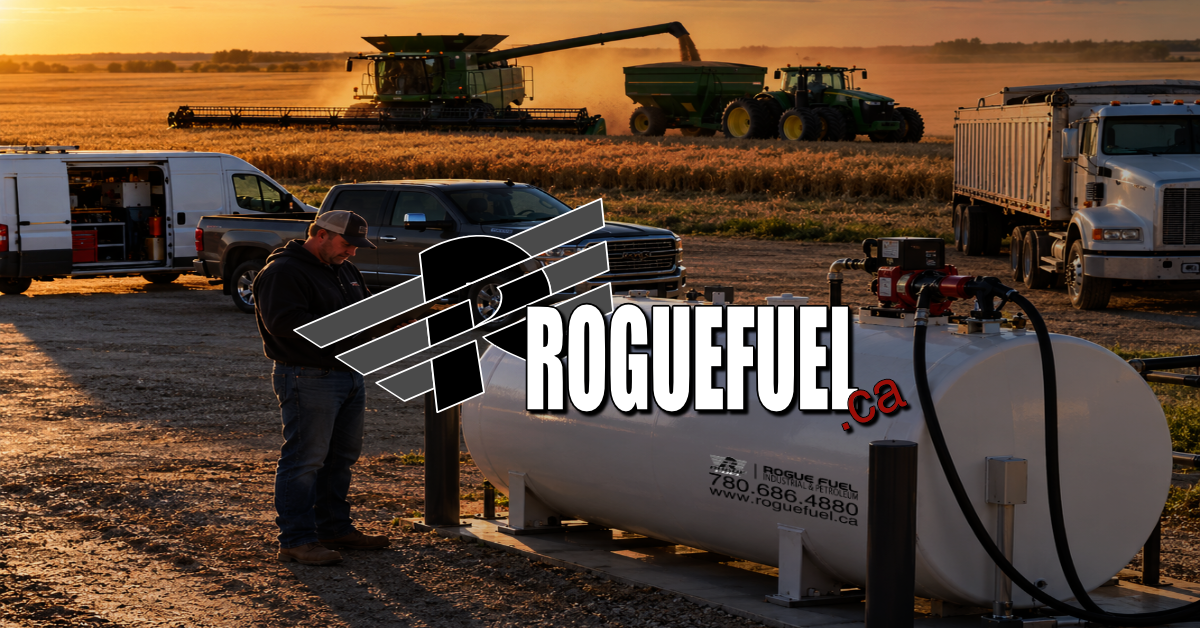
How much fuel do you really use in a year, and is your current storage tank large enough to take advantage of the best purchasing opportunities?
Rogue Fuel breaks down the numbers behind annual fuel consumption, harvest-season diesel demands, delivery fees, unnecessary travel expenses, and the potential return on investment from properly sized fuel storage.
Explore real-world calculations for cars, work trucks, commercial fleets, and agricultural equipment. Discover how a modest $0.10-per-litre difference can translate into hundreds or thousands of dollars in potential annual savings.
From a 500-gallon storage tank to a 48,000-litre fuel load, we're doing the math that could change the way you purchase fuel.
Because every litre matters, every dollar counts, and every win deserves to be celebrated.
HOW BIG OF A FUEL TANK DO YOU REALLY NEED?
The fuel math nobody talks about — and why the right tank could save you thousands.
Buckle up, folks. We're about to do some crazy fuel math!
How much fuel does the average person actually burn through in a year?
What about a contractor with three service trucks? A farmer running combines during harvest? Or a family with two vehicles, a tractor, a skid steer, and enough equipment in the yard to start their own dealership?
More importantly, how much money are you leaving on the table simply because your fuel tank isn't big enough to take advantage of better pricing?
At Rogue Fuel, we ask people a question that sometimes catches them off guard:
"How big is your fuel tank right now?"
We're not asking because we're curious about your impressive collection of steel cylinders.
We're asking because the answer could reveal something important about your annual operating expenses.
And once you start doing the math, that little fuel tank sitting out behind the shop might suddenly look a whole lot more expensive than you thought.
Let's find out why.
First Things First: How Much Fuel Do You Actually Use?
Most people know roughly how much it costs to fill their vehicle.
Ask them how much fuel they use in an entire year, though, and suddenly everyone starts looking at the ceiling.
The truth is, those little weekly fill-ups add up to some pretty serious numbers.
For our examples, we're going to use a deliberately conservative fuel savings estimate of just $0.10 per litre.
That's right. Ten cents.
Not fifty cents. Not some magical discount available only during a full moon when Mercury is in retrograde.
Just ten cents per litre.
Let's start with everyday vehicles.
| Vehicle | Estimated annual fuel use | Annual savings at $0.10/L |
|---|---|---|
| Family car, 60 L per fill, 50 fills/year | 3,000 L | $300 |
| Service van, approximately 4,500 L/year | 4,500 L | $450 |
| Pickup or work truck, 115 L weekly, 52 weeks | 5,980 L | $598 |
These are based on high-use scenarios, not national averages. The van example represents roughly 56 fills of an 80 L tank over the year, while the pickup example assumes a large fuel tank and a full weekly fill.
Think about that.
A family with two vehicles could potentially save several hundred dollars annually just through a better fuel price.
Now imagine a small business with five work trucks.
At roughly $600 in annual savings per truck, that's:
5 trucks × $600 = $3,000 per year.
Ten trucks?
$6,000 per year.
And remember, we're still only talking about ten cents per litre.
We haven't even started discussing the value of fewer trips to the gas station, less time wasted, or the benefits of having fuel available exactly when you need it.
But what about the average Canadian driver?
Not everybody uses 3,000 litres annually.
For example, consider someone driving 20,000 kilometres per year in a vehicle averaging 8 L/100 km.
20,000 km × 8 ÷ 100 = 1,600 litres annually.
At $0.10/L savings, that's $160 a year.
Drive a larger pickup averaging 12 L/100 km over the same distance, and consumption rises to 2,400 litres, representing $240 in potential annual savings.
The more kilometres you drive, the harder your equipment works, and the more fuel you purchase, the bigger these numbers become.
Whether you're filling up monthly, weekly, or so frequently that the employees at the fuel station are considering giving you your own parking spot, there's an opportunity worth calculating.
Farmers, This One's for You: Welcome to Harvest Fuel Math!
Now let's talk about the folks who really know how to make a fuel tank disappear.
Farmers.
If you've ever watched a pair of combines working their way across a field, you know fuel consumption takes on an entirely different meaning during harvest.
Suddenly, a 60-litre passenger vehicle tank looks like something you'd use to fuel the lawn mower.
During harvest, equipment can operate for ten, twelve, or even fourteen hours a day when conditions allow.
And nobody wants to stop harvesting because the fuel tank is empty.
Let's build an example of a busy harvest day.
The following values are working estimates. Actual consumption depends on machine horsepower, crop conditions, terrain, workload, idle time, and equipment efficiency.
| Harvest equipment | Operating assumption | Daily fuel use |
|---|---|---|
| Combine #1 | 55 L/hour × 10 hours | 550 L |
| Combine #2 | 55 L/hour × 10 hours | 550 L |
| High-horsepower field tractor | 30 L/hour × 10 hours | 300 L |
| Grain-cart tractor | 25 L/hour × 10 hours | 250 L |
| Two grain trucks | 45 L each per day | 90 L |
| Support vehicles and miscellaneous equipment | Daily allowance | 60 L |
| Total | 1,800 L/day |
That's 1,800 litres of diesel in a single working day.
Let's keep going.
-
Over 7 harvest days: 12,600 litres
-
Over 14 harvest days: 25,200 litres
-
Over 21 harvest days: 37,800 litres
-
Over 30 harvest days: 54,000 litres
And that's only one harvest fleet.
It doesn't include all the fuel that may be consumed during seeding, spraying, summer fieldwork, grain hauling, livestock operations, snow removal, and the rest of the year.
Some farms consume considerably less. Larger operations can consume far more.
Which brings us to the question we've been waiting to ask.
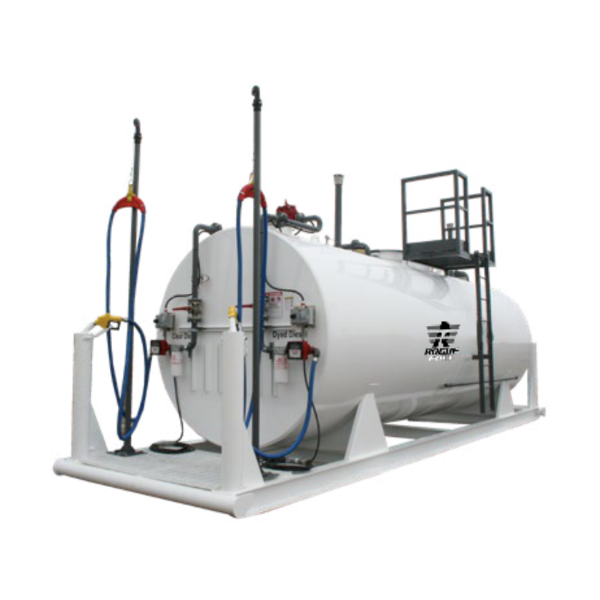
Are you seriously trying to run that operation with a 500-gallon tank?
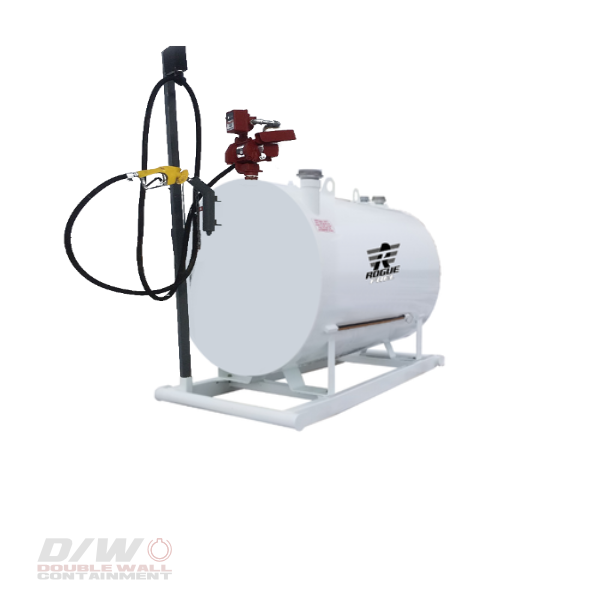
Let's assume your tank holds 500 U.S. gallons, or approximately 1,893 litres.
At 1,800 litres per day, you could burn through almost the entire nominal capacity in a single day.
Even three 550-litre combine fills would consume 1,650 litres.
Your tank would have only about 243 litres left before accounting for any reserve or filling limitations.
And that's assuming it was completely full when you started.
One busy day. One nearly empty tank. One phone call to your fuel supplier.
Now imagine repeating that scenario throughout harvest.
If your fuel supplier is making frequent small deliveries, you may be paying more in trucking or delivery charges than necessary, while missing opportunities to purchase fuel when prices are favourable.
That's not exactly a winning harvest strategy.
And if a delivery doesn't arrive when expected?
Well, nothing improves a beautiful harvest afternoon quite like watching expensive equipment sit idle because somebody forgot to arrange a diesel delivery.
How Big Should Your Farm Fuel Tank Actually Be?
Here's where things get interesting.
The right tank size isn't determined by how much fuel you use in a year alone.
It's determined by how quickly you consume it, how frequently you can receive deliveries, and how much fuel you want available when market conditions change.
A useful starting formula is:
Daily fuel consumption × desired days of supply + operating reserve = target usable storage.
Let's use our 1,800-litre-per-day harvest example.
| Desired coverage | Fuel needed before reserve |
|---|---|
| 1 day | 1,800 L |
| 3 days | 5,400 L |
| 5 days | 9,000 L |
| 7 days | 12,600 L |
| 10 days | 18,000 L |
Now add a 20% operating reserve to the five-day requirement.
9,000 L × 1.20 = 10,800 litres of target usable inventory.
Depending on the tank's permitted working fill, usable capacity, delivery requirements, and available space, a nominal storage system of approximately 12,000 litres or more could be worth evaluating.
This is an example, not a one-size-fits-all recommendation.
You may need considerably more storage if your supplier has a longer delivery lead time, several machines require fuel simultaneously, or you want to purchase larger volumes when prices are attractive.
You may need less if reliable deliveries are frequent and your equipment uses fewer litres per day.
The objective isn't to own the biggest fuel tank on the block.
It's to own the right tank for the amount of fuel your operation actually consumes.
Because a properly sized fuel tank isn't just storage.
It's flexibility.
It's convenience.
It's fuel available when you're ready to work.
And under the right conditions, it's a financial tool that can start recovering its purchase cost.
Can Your Fuel Tank Actually Pay for Itself?
Absolutely, it can — provided the savings justify the total cost of ownership.
Let's run another example.
Imagine a farm or business purchases an appropriately sized, compliant fuel storage system for $9,000 installed.
Its annual fuel consumption is 30,000 litres.
By having enough storage capacity to access better pricing, the owner achieves an average verified savings of $0.10/L compared with their previous purchasing method.
30,000 L × $0.10 = $3,000 annually.
Now suppose the larger storage capacity also allows the business to eliminate four smaller deliveries per year, each previously costing $150.
4 × $150 = $600 in additional annual savings.
Total potential annual benefit:
$3,000 + $600 = $3,600.
A $9,000 system divided by $3,600 annual savings gives a simple payback period of:
2.5 years.
After that, the system could continue generating purchasing and delivery savings for many years.
Now, before anyone runs out and orders a fleet of tanks, remember that a responsible calculation must also include maintenance, financing, insurance, inspection, environmental protection, fuel handling losses, and any costs associated with keeping additional fuel in inventory.
And those pricing savings must actually be available to you.
Still, the bigger point remains.
What looks like an equipment expense today could become an investment that reduces your operating costs year after year.
And the right fuel supplier should be willing to help you run those numbers before you make that decision.
Your Fuel Tank Could Also Be Saving Your Vehicle from Unnecessary Mileage
Here's another expense people rarely calculate.
How much does it cost you just to go buy fuel?
We're not talking about the fuel you needed in the first place.
We're talking about the extra fuel, kilometres, vehicle wear, and time spent travelling to and from the station.
Let's say you make 40 dedicated fuel stops annually, requiring an extra 15 kilometres per round trip.
40 trips × 15 km = 600 unnecessary kilometres per year.
If your vehicle consumes 12 L/100 km:
600 × 12 ÷ 100 = 72 litres of fuel burned just to purchase more fuel.
At $1.50/L, that's:
$108 per year in extra fuel costs.
Now allow another $0.10 per kilometre as a simplified maintenance-and-wear estimate.
600 km × $0.10 = $60.
That's $168 per year in additional vehicle operating costs.
And it still doesn't include your time.
Suppose each dedicated fuel run takes 20 minutes.
40 trips × 20 minutes = 13 hours and 20 minutes annually.
What's your time worth?
What could you accomplish with another thirteen hours in your business?
How much would you rather spend that time with your family instead of standing beside a fuel pump in February, questioning every life decision that brought you there?
For a contractor with multiple vehicles, the unnecessary travel and labour costs can add up quickly.
Of course, not every fuel stop is a special trip. If you already pass a station on your regular route, there may be little or no additional driving to eliminate.
But if you're regularly sending staff and equipment out of the way for fuel, those costs are worth measuring.
And can we talk about service stations for a minute?
Remember when a service station actually provided service?
You could stop for fuel, check your tires, ask for directions, and maybe even find someone who knew how to read a map.
These days, you're lucky if there's a working tire inflator or someone who can point you toward the mailbox at the far end of the parking lot.
We're joking, of course.
Mostly.
There are still excellent service stations and hardworking people operating them.
But when your business depends on fuel, convenience and reliable service should be more than a pleasant surprise.
What Happens When the Savings Are More Than Ten Cents?
So far, we've used only $0.10/L for our calculations.
Why?
Because we want to demonstrate how relatively small price differences become meaningful when multiplied by an entire year's fuel consumption.
But pricing opportunities are not always limited to ten cents.
Depending on market conditions, purchase volume, delivery arrangements, timing, and customer eligibility, the price differences available through a fuel purchasing network may sometimes be larger.
Let's compare three potential savings scenarios.
| Annual fuel purchased | Save $0.10/L | Save $0.15/L | Save $0.25/L |
|---|---|---|---|
| 3,000 L | $300 | $450 | $750 |
| 6,000 L | $600 | $900 | $1,500 |
| 15,000 L | $1,500 | $2,250 | $3,750 |
| 30,000 L | $3,000 | $4,500 | $7,500 |
| 50,000 L | $5,000 | $7,500 | $12,500 |
| 100,000 L | $10,000 | $15,000 | $25,000 |
Take a good look at that last line.
At 100,000 litres per year, a ten-cent difference is worth $10,000.
At twenty-five cents, it's $25,000.
That's a serious amount of hard-earned money.
Money that could help pay for equipment repairs, tires, operating expenses, employee wages, family vacations, or simply remain in the bank for the future.
And wouldn't it be nice to keep a little more of what you've worked so hard to earn?
Let's Talk About 48,000 Litres of Fuel
Now we're getting into the really fun math.
Consider a fuel delivery load of 48,000 litres.
If that fuel is purchased at $1.50/L, the total fuel value is:
48,000 × $1.50 = $72,000.
Seventy-two thousand dollars in fuel.
Now suppose a purchasing arrangement saves customers just $0.10/L compared with another available option.
48,000 × $0.10 = $4,800 saved on that volume.
At $0.15/L, the difference becomes $7,200.
At $0.25/L?
$12,000.
On 48,000 litres.
That's before considering any additional benefits from favourable purchasing arrangements or reduced delivery costs.
And what if we repeated that every week?
This next example is a purchasing-volume illustration, not a claim that every customer buys that much fuel or receives the same discount.
48,000 litres × 52 weeks = 2,496,000 litres annually.
| Savings per litre | Savings per 48,000 L | Annual equivalent at 52 loads |
|---|---|---|
| $0.10 | $4,800 | $249,600 |
| $0.15 | $7,200 | $374,400 |
| $0.25 | $12,000 | $624,000 |
That's right.
At an average savings of only ten cents per litre, that purchasing volume represents nearly a quarter of a million dollars in annual price differences.
Now imagine what opportunities exist when customers work together through a network focused on reducing their fuel expenses.
At Rogue Fuel, we believe those numbers deserve attention.
Because a few cents might not sound like much when you're standing at the pump.
But a few cents multiplied by millions of litres?
That's an entirely different conversation.
Why Fuel Storage Capacity Can Help You Take Advantage of Seasonal Pricing
Fuel prices change.
That's hardly breaking news.
But there is a difference between knowing prices fluctuate and having the flexibility to do something about it.
If your tank is constantly running empty, you don't always get to choose when you buy.
You buy when you have to.
And when you have to buy, your negotiating flexibility may be limited.
With appropriately sized storage, you may be able to:
- Purchase a larger quantity when a favourable price becomes available.
- Reduce how frequently deliveries are required.
- Qualify for volume-based price breaks where suppliers offer them.
- Maintain a useful reserve for periods of high demand.
- Reduce emergency orders during harvest or other busy seasons.
- Schedule deliveries around your operation instead of stopping your operation to wait for deliveries.
That doesn't mean every large purchase will save money.
Fuel prices can move either direction.
You also have to consider the cost of financing inventory, maintaining fuel quality, and storing it safely.
A tank that sits full of fuel you won't use for an extended period is not necessarily a good investment.
The goal is to have enough storage to take advantage of opportunities without creating unnecessary costs.
That's the balance we're interested in helping customers find.
Single-Wall, Double-Wall, 500 Gallons, or 15,000 Litres: What Should You Choose?
There is no universal answer.
A homeowner, a contractor, a trucking company, and a farm running multiple combines have very different requirements.
A 500-gallon tank might be plenty for one property and completely inadequate for another.
There are also important differences between U.S. gallons and imperial gallons. A 500 U.S.-gallon tank holds approximately 1,893 litres, while a 500 imperial-gallon tank holds approximately 2,273 litres.
So before we start ordering tanks, let's make sure we're talking about the same capacity.
Tank construction matters, too.
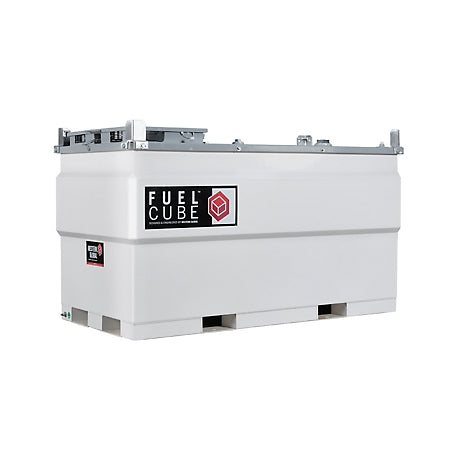
Single-wall tanks generally require consideration of appropriate secondary spill containment, depending on the installation and applicable requirements.
Double-wall tanks provide an additional containment barrier that can reduce the consequences of a leak from the primary tank when properly designed, installed, inspected, and maintained.
Any fuel storage installation should be assessed for applicable codes, local requirements, environmental protection, safe placement, fire protection, equipment compatibility, and insurance conditions.
A properly designed system should protect more than your fuel.
It should protect your property, your business, your employees, and the environment.
We would much rather help you find the right solution than see you buy something that doesn't suit your actual needs.
And here's something worth remembering:
You don't have to choose a particular tank manufacturer just because you're talking to Rogue Fuel.
Our goal is to help point you toward a suitable solution based on your operation, budget, location, and requirements.
Big Companies Talk About Record Profits. We'd Rather Talk About Your Savings.
You've probably noticed something about the way large corporations advertise.
Record revenues.
Record earnings.
Record quarterly profits.
Congratulations to them.
But here's a question.
How are those record numbers helping the people who purchase the fuel?
What matters to us at Rogue Fuel is helping the hardworking people, families, farmers, contractors, and businesses in our communities keep more of their money.
Whether that's through better fuel purchasing opportunities, dependable support, helpful advice, or simply taking the time to explain the numbers, our focus is on providing real value.
We're not particularly interested in convincing you that a complicated rewards program is the greatest invention since the internal combustion engine.
Points are fine.
Loyalty programs can have value.
But you should always compare their real dollar value against the price you're actually paying.
Because earning points you can someday redeem isn't necessarily better than spending less money in the first place.
And nobody should need a calculator, three apps, and a six-month promotional offer just to figure out whether they saved five dollars.
We believe good service should be straightforward.
Good advice should be useful.
And real savings should show up in your operating costs.
Your success is worth celebrating. And every dollar you don't have to spend unnecessarily is another dollar you get to decide what to do with.
So, How Large of a Fuel Tank Do You Really Need?
Now that we've put you through enough math to make your high school teacher proud, here's where we'd like you to start.
Ask yourself:
-
How many litres of fuel do I purchase every year?
-
How much fuel do I use during my busiest week?
-
How large is my current tank, and how often am I refilling it?
-
Am I paying unnecessary delivery or trucking fees?
-
Can I take advantage of better pricing when it becomes available?
-
How much time and mileage do I spend going out of my way to purchase fuel?
-
Is my current fuel supplier doing everything reasonably possible to help me reduce my costs?
That last question might be the most important one of all.
Because you don't necessarily have to change everything about your operation to improve your bottom line.
Sometimes, it starts with asking a better question.
Sometimes, it starts with getting a second opinion.
And sometimes, it starts with realizing your fuel tank is too small.
We Want to Hear Your Fuel Math!
Now it's your turn.
We're genuinely interested in hearing how much fuel you use.
Whether you're operating a family vehicle, running a service business, driving a transport truck, or managing an entire farm, we'd love to compare experiences.
Tell us in the comments:
- How many litres of fuel do you estimate you use annually?
- What size fuel tank do you currently have?
- How often do you need a delivery or make a fuel stop?
- Is your storage capacity large enough to take full advantage of available price breaks?
- Have you calculated how much money and driving time you could save with a different approach?
And for the farmers out there, we'd especially love to know how many litres your equipment burns through on a busy harvest day.
Have you ever stopped to calculate what your entire fleet consumes over a full season?
We have a feeling some of those numbers are going to be absolutely wild.
Share your experiences, compare your calculations, and let us know what has worked for you.
You might even help another farmer, family, or business owner discover an opportunity they never considered.
Your Fuel Supplier Should Be Working for You
If you take nothing else away from our articles, please remember this:
You work hard for your money. Your fuel supplier should be working hard to help you keep more of it.
It doesn't matter where you live, who currently supplies your fuel, or which tank manufacturer you prefer.
If you're unsure whether your current setup is serving you well, give Rogue Fuel a call.
We can talk through your estimated fuel usage, explore practical storage options, and help point you in the direction of a tank that suits your needs.
No unnecessary pressure.
No complicated sales pitch.
Just useful conversations about fuel, operating expenses, and opportunities to save.
And if your current supplier isn't doing everything they reasonably can to help you, perhaps it's time to ask yourself why you haven't explored the other options already available to you and your family.
At Rogue Fuel, we're focused on exceptional service, stronger communities, and helping you make every litre count.
Because every litre matters.
Every dollar counts.
And every win deserves to be celebrated.
Give us a call or contact us anytime, share your fuel math, and let's find out how much more you could be using to fund your growth and operations in other departments.
Rogue Fuel
62-27507 TWP RD 544
Sturgeon County, Alberta, Canada
T8R 2B5
📞 Call: 780-686-4880
✉️ Mail: info@roguefuel.ca
🌐 Visit: https://www.roguefuel.ca
👍 Facebook: https://www.facebook.com/roguefuelcanada
📸 Instagram: https://www.instagram.com/roguefuelcanada
📺 YouTube: https://www.youtube.com/@MunroIndustries
🖥 Linkedin: https://www.linkedin.com/company/rogue-fuel
🌍 Main Directory: https://www.munroindustries.com